Follow
Searching for luxury property across international borders has never been more complex, or more full of opportunity. Whether you are browsing a broad platform like ri real estate com or consulting with a boutique agency that specializes exclusively in high-end markets, the path you choose will significantly shape your buying experience and your results.
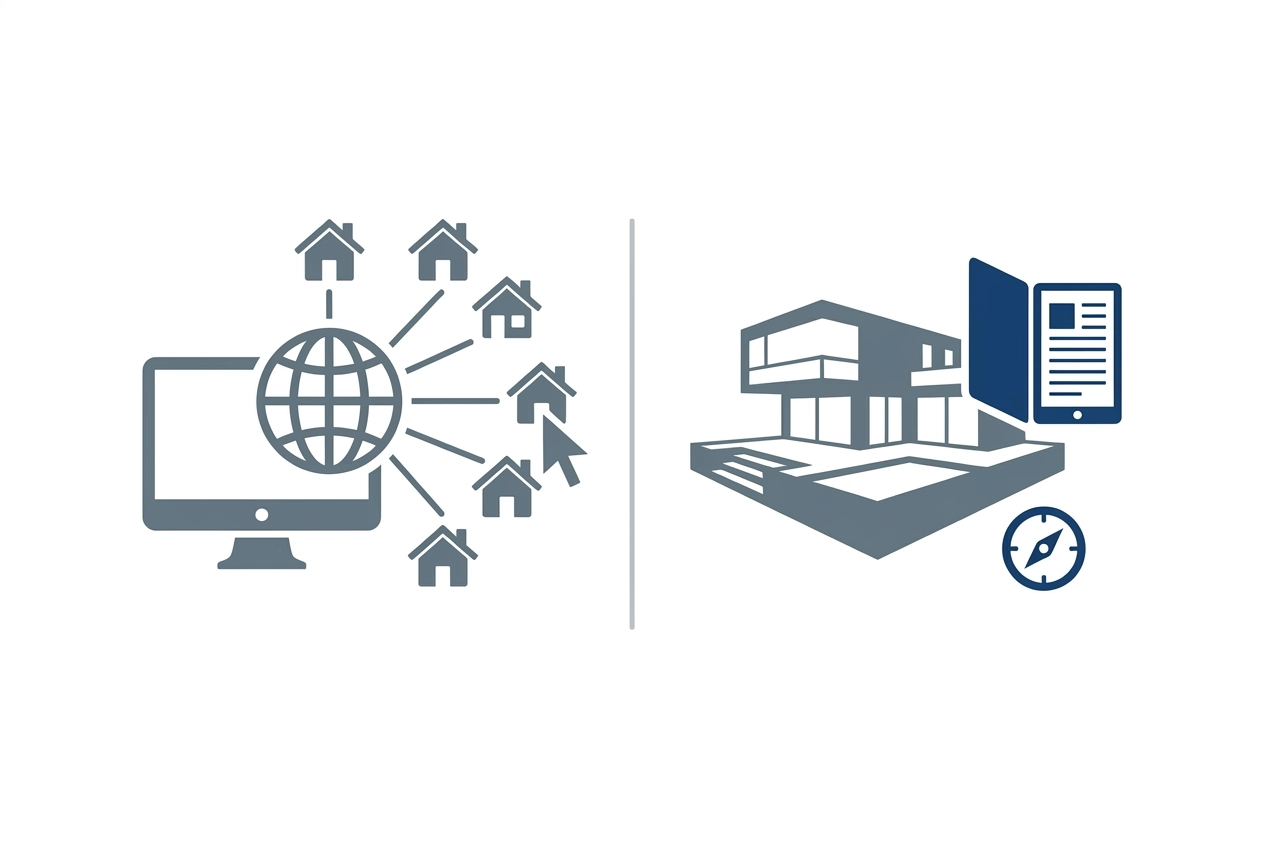
Both options come with distinct advantages and real limitations, and understanding those differences is essential before committing to a purchase that could involve millions of dollars and multiple jurisdictions. International real estate portals offer scale, convenience, and immediate access to thousands of listings. Luxury specialist agencies offer depth, discretion, and market intelligence that no algorithm can replicate.
In this post, we will break down exactly how these two approaches compare across the metrics that matter most to serious global buyers: listing quality, market access, negotiation support, and long-term investment guidance. By the end, you will have a clear framework for deciding which resource, or which combination of both, belongs in your property search strategy.
The Global Luxury Property Market in 2026: A Defining Moment
The numbers defining 2026 leave little room for ambiguity: global direct real estate investment surged 28% year-over-year in Q2 2026, with Asia Pacific leading all regions at 38% growth, marking the region’s most active second quarter in five years, according to JLL’s Global Market Perspectives report. Japan and Australia drove much of that regional momentum, with Singapore recording exceptional performance alongside them. This is not a localised uptick; it reflects a structurally recalibrated global market gaining genuine velocity.
Zooming out further, the global real estate market was valued at $4,892.6 billion in 2025 and is projected to reach $8,214.3 billion by 2034, growing at a CAGR of 5.9%, with residential property commanding a 42.3% share of total market value. Within that vast landscape, the luxury segment is carving out an increasingly dominant position.
Sotheby’s International Realty president Philip A. White Jr. confirmed that the luxury segment outperformed the broader housing market in 2025, driven by rising inventory, expanding international buyer participation, and a significant increase in all-cash transactions at the premium end. Moody’s Analytics chief economist Mark Zandi reinforced this picture, noting that top-end buyers are in strong financial shape and largely insulated from macroeconomic headwinds, including interest rate movements.
Agents transacting properties above $10 million reported the highest optimism levels of any cohort surveyed for 2026, with White stating that luxury property buyers are less constrained by geography, a signal that cross-border activity is accelerating rather than softening. For sophisticated investors and buyers navigating this environment, understanding both regional dynamics and global capital flows has never been more consequential.
What International Real Estate Portals Actually Offer

International real estate portals offer a genuinely useful starting point for buyers entering an unfamiliar market. With approximately 900 active real estate marketplaces operating worldwide, the portal ecosystem provides broad geographic coverage, aggregated listing volumes, and self-directed search functionality that allows buyers to orient themselves independently during the early research phase of a cross-border property decision. For a buyer encountering a new city or country for the first time, this accessibility has real value: it establishes baseline price expectations, surface-level neighbourhood context, and a preliminary sense of available property types before any professional engagement begins.
Market data dashboards and price trend tools on major platforms extend this orientation function. Country or city-level benchmarks allow buyers to compare broad price trajectories across markets and identify which regions fall within their acquisition range. However, these tools operate at an altitude that rarely serves serious purchase decisions. The suburb-level granularity that separates a well-priced premium acquisition from an overexposed or underperforming asset is not something portal dashboards reliably deliver, particularly in markets where transaction data is not publicly mandated. As the JLL Global Real Estate Transparency Index documents across 89 countries and 151 cities, meaningful data gaps persist even within highly transparent markets, and in lower-transparency jurisdictions, portal asking prices may carry no validated transaction benchmark at all.
The structural ceiling for portal utility becomes most apparent at the ultra-high-net-worth level. Portals present exclusively on-market inventory; they are, by design, public discovery interfaces. The most significant luxury transactions, those conducted with discretion, bespoke pricing, and private negotiation, occur entirely off-market and are therefore invisible to any portal user. As real estate technology strategist Mike DelPrete has noted, exclusive off-market content represents the single most potent structural threat to portal dominance, precisely because serious buyers follow access to inventory, not interface quality.
Beyond inventory limitations, portals carry no relationship infrastructure of any kind. They provide no access to local professional networks, no cross-border legal coordination, no guidance on foreign ownership regulation, financing structures, or currency transfer compliance, and no capacity to manage the logistical complexity that a multi-million dollar international transaction demands. For buyers transacting across unfamiliar legal jurisdictions, this is not a minor inconvenience; it is a structural gap that portals are not built to address and show no commercial incentive to resolve.
What a Luxury Specialist Realty Delivers That Portals Cannot
Where international portals reach their limit, a luxury specialist realty begins its most consequential work. The five capabilities outlined below represent a structural advantage that no aggregation platform, however sophisticated, can replicate.
Off-Market Access: The Invisible Inventory
The most significant properties in Sydney’s Eastern Suburbs rarely appear on any portal. In established enclaves such as Double Bay, Bellevue Hill, Vaucluse, and Point Piper, a substantial proportion of trophy transactions are negotiated entirely in private, with discretion functioning as a non-negotiable condition for both parties. A vendor selling a $30 million residence on a quiet Point Piper headland has no interest in public listing activity, open inspections, or digital footprints. The buyer acquiring it requires equally protected anonymity. This invisible layer of the market is accessible only through relationships cultivated over years, and it represents precisely the segment where UHNWIs transact most actively. No portal, regardless of its international reach or algorithmic sophistication, can index what is never listed.
Suburb-Level Intelligence That Changes Negotiation Outcomes
Granular, submarket intelligence is what converts a data point into a negotiating advantage. Knowing the median sale price in Bellevue Hill is useful; knowing the specific vendor’s motivation, the recent comparable sales that a formal appraisal would rely on, and the development context affecting adjoining lots is decisive. This depth of intelligence is assembled through direct agency relationships and data partnerships with CoreLogic, Domain, and REA Group, and it exists nowhere on the public internet in usable form. The PwC/ULI Emerging Trends in Real Estate 2026 report explicitly highlights a shift toward asset and submarket-level focus as the new baseline for sound investment decision-making, a direct industry acknowledgment that macro data and portal searches are insufficient for high-stakes decisions.
A Cross-Border Buyer Network No Algorithm Can Replicate
Established relationships with UHNWI buyers and qualified intermediaries in Hong Kong, Singapore, mainland China, the Middle East, and the major European financial centres constitute an active transactional pipeline. When a premium Sydney listing becomes available, the first call goes to this network, not to a public portal. Sotheby’s International Realty president Philip A. White Jr. confirmed that luxury buyers are increasingly “less constrained by geography,” and Asia Pacific posted its most active second quarter in five years in 2026, with investment up 38% year-over-year. Capturing internationally mobile capital requires human relationships operating across time zones and cultures, not a keyword search.
An Integrated Services Ecosystem for Complex Transactions
A cross-border luxury acquisition involves far more than a purchase contract. Private banking introductions, independent legal counsel, currency structuring, contractor referrals, relocation logistics, and insurance placement are all components of a transaction that a portal cannot address. In 2026, lifestyle-driven buyers arriving from global markets expect comprehensive, white-glove service delivery as a baseline, not a premium.
Strategic Advisory as the Highest-Order Differentiator
The Emerging Trends in Real Estate 2026 report, drawing on insights from more than 1,700 leading investors, developers, and advisers, frames the current environment as one of genuine uncertainty requiring insight combined with agility. As PwC’s Tim Bodner noted, “the most successful firms will be those that adapt quickly to new dynamics while keeping an eye on the long term.” A trusted specialist adviser positions clients to act decisively when the right opportunity emerges, transforming market fog into a competitive advantage that no search algorithm can provide.
Portal vs. Specialist Agency: A Side-by-Side Assessment
The distinction between portal search and specialist agency representation becomes most consequential at the point where transaction complexity and asset value converge. The following five dimensions illustrate precisely where the divergence occurs.
Listing Access. International portals index on-market inventory only, drawing from publicly listed MLS and aggregated feed data. Specialist luxury agencies maintain curated off-market and pre-market pipelines that represent the highest-value and most discreet properties in any given market. In inventory-constrained luxury precincts, where premium waterfront holdings rarely turn over through public channels, a buyer relying exclusively on portal search is operating on a materially depleted inventory set from the outset.
Market Intelligence. Portals surface macro price trend data at the city or regional level, which provides useful orientation but insufficient precision for high-value decisions. Specialist agencies deliver hyper-local transaction intelligence: vendor context, precinct-level absorption rates, list-to-sale ratios at the individual street level, and comparative analysis that accounts for micro-variables no algorithm weights accurately. This is the difference between knowing a market is rising and knowing which specific asset represents value at a given moment.
Buyer and Seller Networks. Portals facilitate anonymous self-service browsing, by design. Specialist luxury agencies operate within active networks of qualified buyers, sellers, family offices, and international intermediaries across global feeder markets. With Asia Pacific real estate investment up 38% year-over-year in Q2 2026 and geography-agnostic buying accelerating at the premium end, access to those cross-border networks is a material transactional advantage, not a supplementary benefit.
Transaction Support. Portals provide no post-search infrastructure. Full-service luxury agencies coordinate private banking relationships, legal counsel, property management, relocation services, and insurance, compressing the transaction lifecycle and reducing friction at every stage. The Rhode Island Association of REALTORS® documents the breadth of professional services that serious transactions require, none of which a portal facilitates.
Discretion and Privacy. Portals are inherently public by design. For clients transacting in the $5 million-plus tier, public listing exposure creates negotiating risk, security considerations, and reputational complexity that specialist agencies are structured to eliminate entirely. For many UHNWI clients, managing acquisition or divestment without public exposure is not a preference; it is a prerequisite.

Why Sydney and Australia Are Central to the Global Luxury Conversation in 2026
Australia’s emergence as a co-leader of Asia Pacific’s investment recovery in Q2 2026 is not an isolated data point. It is a structural signal. According to JLL’s Global Real Estate Perspective, the Asia Pacific region posted its most active second quarter in five years, with direct real estate investment rising 38% year-over-year, outpacing every other major global region including the Americas (up 26%) and EMEA (up 27%). Australia and Japan led regional liquidity, with Singapore recording supplementary exceptional growth in the same period. For internationally mobile capital seeking premium residential exposure, this positions Australia not merely as a regional story but as a globally competitive allocation target, operating at the tier where institutional confidence and private wealth intersect.
The investment case extends well beyond a single quarter. The Australian luxury residential real estate market carries a defined forecast horizon running from 2026 through 2031, with growth tracked across apartment and condominium segments, villas and landed houses, and across both sales and rental transaction models. This multi-axis growth profile is significant. It means opportunity is not concentrated in a single product type or buyer category. Owner-occupiers, portfolio investors, and yield-seeking institutional buyers each have a viable entry point within the same market framework, a breadth of participation that reinforces long-term liquidity and price support across the premium tier.
The buyer profile driving this market is itself evolving in ways that carry real consequences for location strategy and property specification. Technology founders, finance executives, and e-commerce entrepreneurs are increasingly prominent at the top end of Australian residential transactions. Described as unanchored from traditional business districts, this cohort is expanding the geographic and lifestyle-preference landscape well beyond the historical Sydney CBD premium corridor. Their purchasing decisions are driven by access to lifestyle infrastructure, privacy, and amenity rather than proximity to a corporate headquarters, a shift that fundamentally alters which postcodes command premium valuations.
That geographic dispersal is already reflected in the data. Australian luxury property is no longer a Sydney-Melbourne duopoly. High-end demand has spread to the Gold Coast, the Sunshine Coast, Perth, and regional coastal and alpine markets, with Sunshine Coast prices having risen more than 150% over the past decade. Lifestyle and wellness have supplanted proximity to business districts as the primary location driver, restructuring the competitive hierarchy among Australian markets.
The precise nature of that wellness demand is worth noting. In 2026, buyers at the premium end are specifying properties equipped with AI air purification systems, sleep optimisation technology, and advanced water filtration. The expectation has shifted from postcode prestige toward full health ecosystem delivery. This is a buyer expectation that requires specialist advisory capability to satisfy reliably. Navigating it through a portal search alone, without access to advisers who understand both product specification and supplier networks, introduces a gap between what buyers want and what they can locate and verify independently. The residential real estate market’s continued segmentation toward lifestyle-driven premium categories only sharpens that advisory requirement for buyers operating across borders.
Selecting the Right Partner for a Cross-Border Luxury Transaction
Selecting an agency for a cross-border luxury transaction requires a fundamentally different evaluation framework than choosing a domestic sales partner. The five criteria below provide a structured basis for that assessment.
Documented cross-border track record at the $5M-plus price point. Domestic sales volume is not a proxy for international transaction competence. The legal, financial, and logistical complexity of cross-border acquisition or divestment at the ultra-prime level demands specific experience: navigating foreign ownership regulations, managing multi-jurisdiction due diligence, and coordinating across legal systems simultaneously. According to what real estate professionals need to know about luxury transactions, luxury real estate represents a distinct segment with its own expectations and complexities, demanding competencies well beyond standard residential practice. Ask for documented examples of completed international transactions at comparable price points, not aggregate portfolio figures.
Active relationships in Sydney’s key feeder markets. For Sydney acquisitions, the relevant inbound buyer corridors originate from Hong Kong, Singapore, mainland China, the Middle East, and European financial centres. Passive listing exposure across these corridors is insufficient. An agency with pre-established relationships in these markets can facilitate off-market introductions on both the buy and sell side, a capability that reactive outreach cannot replicate. The NAR Working with International Clients framework recognises international buyer representation as a recognised professional specialty, reinforcing that feeder-market relationship depth is a verifiable, structured competency.
Off-market pipeline depth over public listing count. The most significant UHNWI transactions are conducted privately. Industry consensus places the share of ultra-prime transactions occurring off-market at well above 50%, making an agency’s discreet pipeline a more meaningful capability indicator than its public-facing inventory. An agency’s access to pre-market and off-market stock reflects trust relationships built over time, not a listing agreement signed last month.
Integrated professional services depth. Access to private banking, independent legal counsel, trusted contractors, relocation logistics providers, and insurance placement are core transaction requirements at the premium end, not ancillary conveniences. Cross-border investors must navigate foreign ownership law, stamp duty surcharges, AML and KYC compliance, and potential double-taxation exposure. An agency that maintains structured, accountable relationships with specialists across each of these disciplines reduces execution risk materially. Evaluate the advisory ecosystem as part of the agency relationship itself.
Local headquarters combined with genuine global reach. The optimal agency profile for internationally mobile buyers or sellers is one physically headquartered in the target market, with active global marketing distribution and direct international buyer relationships. Deep Sydney market knowledge, paired with cross-border transaction experience and established presence in the feeder markets listed above, represents the combination that minimises both execution risk and information asymmetry across multiple jurisdictions simultaneously.
Kincade International Realty: Sydney’s Gateway to Global Luxury Property
Headquartered in Double Bay, Sydney, Kincade International Realty operates at the precise intersection where Eastern Suburbs market knowledge meets verified international reach. The firm serves buyers, sellers, and renters seeking premium residential properties across Sydney and global markets, with a group structure that extends across the United States, United Kingdom, alpine markets, and family office services. This architecture is not incidental; it reflects a deliberate positioning as the advisory partner of choice for globally mobile clients whose property decisions span multiple jurisdictions and asset classes.
Kincade’s service model extends well beyond conventional listing and transaction facilitation. Through its Kincade Advisory Service and Kincade Concierge Services, the firm provides introductions to legal counsel, mortgage advisers, building inspectors, interior designers, and relocation support, delivering the fully integrated transaction infrastructure that ultra-high-net-worth clients require. This is the critical distinction that separates a luxury specialist from a portal-dependent generalist: the ability to manage complexity, not merely present inventory.
Listing distribution through established international luxury platforms, including JamesEdition, ensures Kincade-listed properties reach qualified buyers in feeder markets that standard Australian residential portals do not serve. For sellers, this means accessing demand pools that are structurally invisible to portal-reliant competitors. For buyers, it means working with advisers who carry hyper-local Double Bay and Eastern Suburbs intelligence alongside a genuine international buyer network.
For a confidential consultation on acquiring, divesting, or exploring Sydney’s luxury rental market, Kincade’s advisers provide tailored private guidance without public exposure.
Conclusion
Navigating the global luxury property market requires more than a search bar and a shortlist. The right approach depends on your priorities. International portals deliver speed, scale, and broad market visibility. Specialist agencies deliver discretion, negotiation power, and the kind of insider access that rarely appears online. For most serious buyers, the smartest strategy combines both: use portals to research markets and benchmark pricing, then engage a trusted specialist to execute at the highest level.
Before your next search, ask yourself what you value more: convenience or competitive advantage. The answer will guide every decision that follows.
Ready to move forward with confidence? Start by defining your investment criteria clearly, then align yourself with the professionals and platforms built to deliver exactly that. The world’s finest properties are waiting; the right path gets you there faster.